

EBSCOhost is research platform that allows you to search a variety of different databases such as CINAHL, Health Business Elite and Medline. This guide provides an overview of how to use EBSCOhost to find research literature such as journal articles.

To use EBSCOhost, you'll need to make sure you have a valid OpenAthens login. You can register for an OpenAthens account by visiting https://openathens.nice.org.uk while using an NHS PC, ideally with an NHS email address. If you are unable to do this, it will take longer for your account to be authorised.

Before you begin using EBSCOhost, it’s a good idea to think about the search terms you want to use. Planning what you want to search for in advance will help improve the relevancy of the results you find. Remember that the largest databases contains tens of millions of records, so being specific is important!
Using a search framework can help you develop your question, or break your topic down into the most essential keywords. You should ask yourself if there are any other ways to describe the concept you are searching, as well as whether there are any singular and plural variations, UK/US spellings etc. that you'll need to consider.
For more in-depth advice on planning your search, read our Introduction to Literature Searching guide.
 Before you begin your search, you also need to choose the most appropriate database(s) for your topic or research area. Visit the Online Resources tab at the top of the page to learn more about each database and their subject coverage.
At UHCW, you can search the following databases via EBSCOhost:
Once you’ve chosen where you want to search, click the appropriate link and login with your OpenAthens username and password. The screenshots within this guide have been taken from a search of CINAHL.
Note: Some databases like Medline are available to search in multiple tools; make sure you follow the link to the right one.
Here's an example of the EBSCO search screen and a brief key to it's various features:
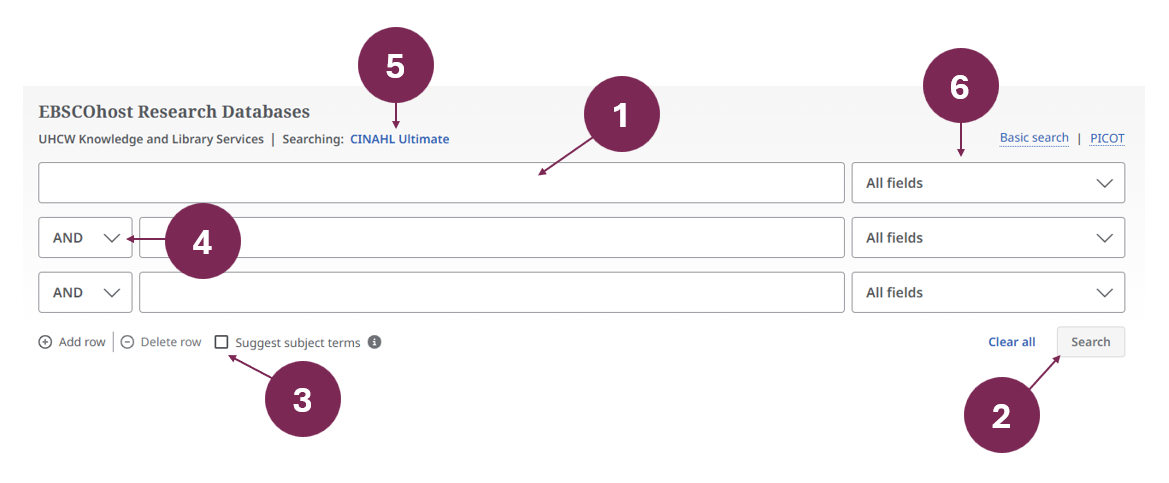
1) Search box – enter your search terms here.
2) Search – click this button to run a keyword search.
3) Suggest Subject Terms – make sure this box is ticked before clicking Search in order to find Subject Headings.
4) Search operators – use these operators to combine your individual search lines.
5) Databases – check here to see which database you are searching.
6) Select a Field – choose where you would like to search for a keyword e.g. title, abstract etc.
Subject Terms (also known as Subject Headings) are specific terms assigned to records to describe the content of that article. It can be helpful to see if there are any terms related to your topic as they help cater for things like spelling variations. Make sure the ‘Suggest Subject Terms’ box is ticked before you click the search button:

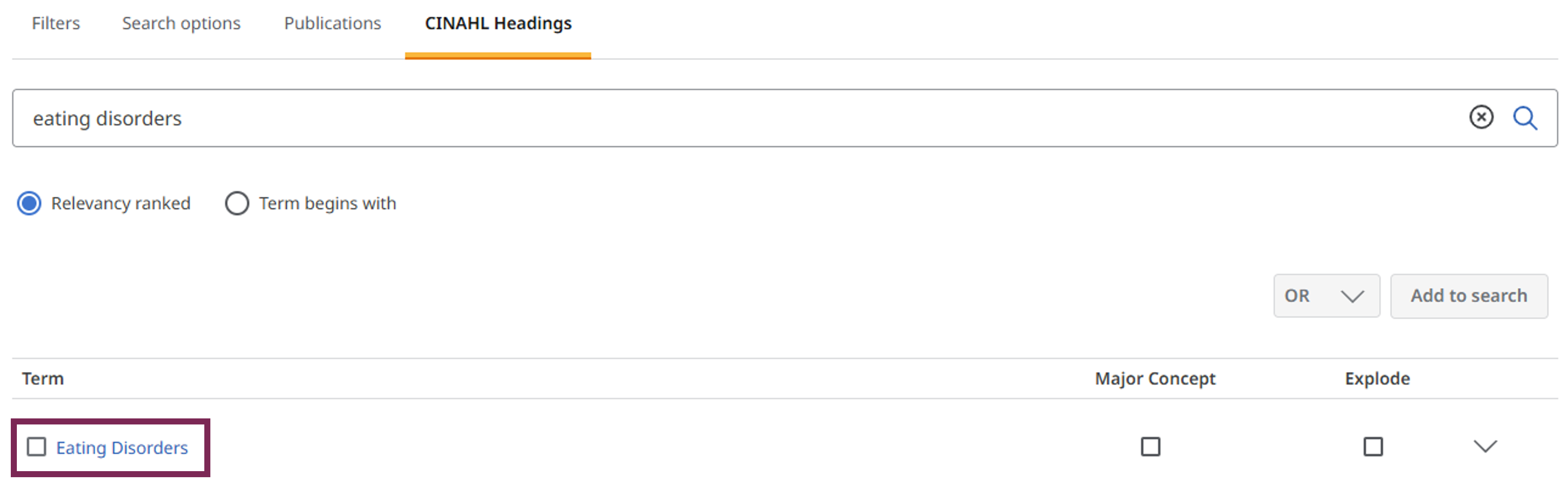
EBSCOhost will compare your term to the list of subject terms that have been used in the database you are searching. You might find an exact match or be presented with a list of close matches. If you aren’t sure which one to choose, click on the Subject Term for more detail on how it has been used:
Once you’ve chosen a subject term, you’ll also be offered a selection of subheadings to search:
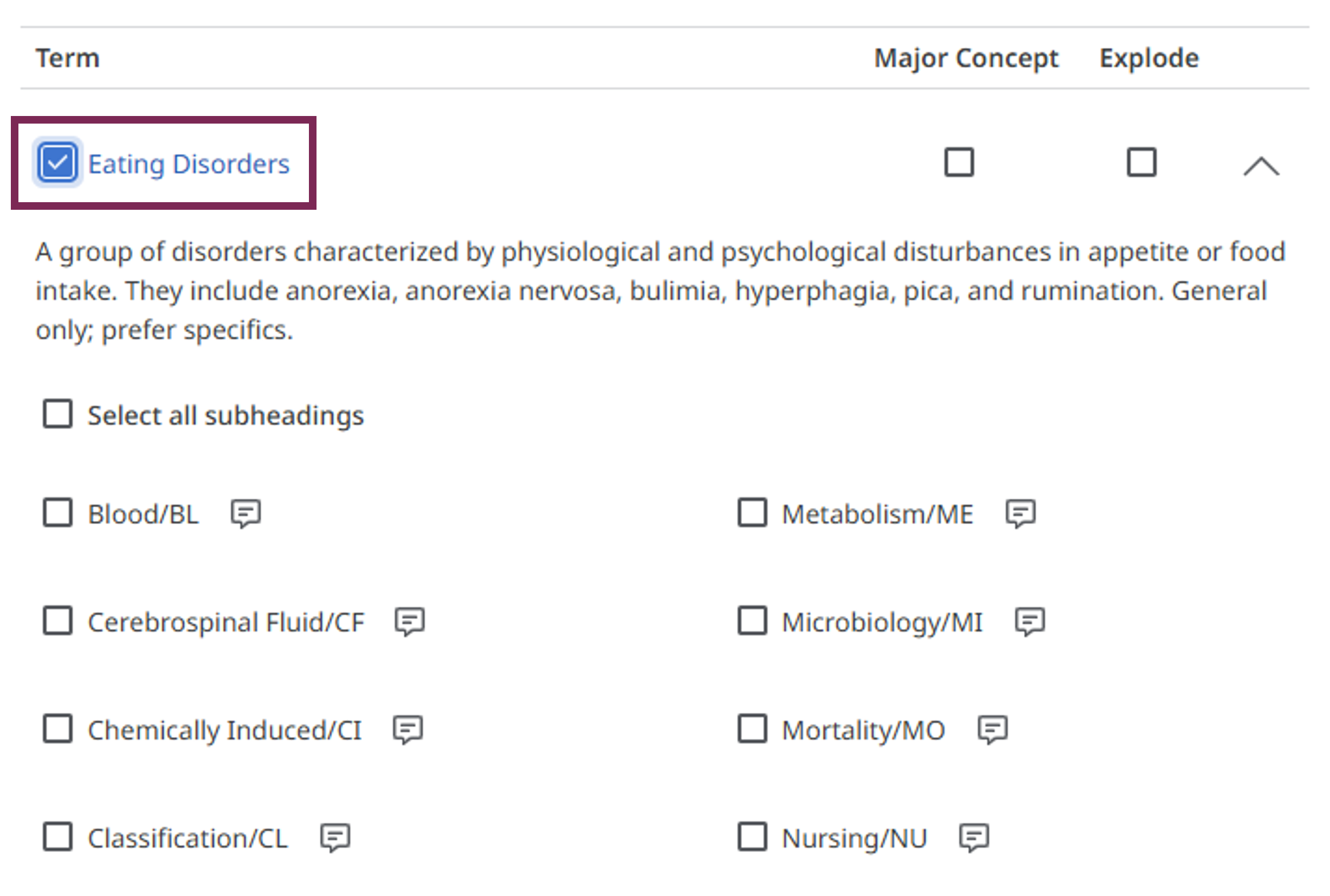
Ideally, at the beginning of your search you should include all subheadings to ensure you don’t miss out on any relevant results. Click ‘Add to search’ to add your subject heading to your search strategy above, then click 'Search'.
Remember: The use of Subject Headings is tightly controlled, so there may not necessarily be one for your topic area. In this case, you will need to explore different keywords to describe your topic.
As mentioned earlier in this guide, keyword searches need to cater for spelling variations, word endings and synonyms. Capturing all these variations can feel time-consuming, so you might want to try these techniques to make your search more efficient:
 Truncation
Try using the * symbol in your keyword search to capture plurals and different word endings.
e.g. reduc* will find reduce, reduces, reduced, reduction etc.
 Wildcard
Try using the ? symbol in your keyword search to substitute a character or none.
e.g. behavio?r will find behaviour and behaviour.
 Proximity Searching
Use the N operator between two keywords to find articles where your keywords appear next to each other, in any order.
Add a number to make the search more flexible: e.g. lung N3 cancer will find results where lung and cancer appear within 3 words of one another.
In EBSCOhost, you need to enter your search terms one by one. Your results will appear in the search history below the search box. Avoid typing whole sentences, or words such as ‘in’ or ‘of’ as EBSCOhost will search for them as an exact phrase.
Having searched for your keywords and subject headings separately, you now need to combine them in order to get a final set of papers that cover all the topics you are interested in.
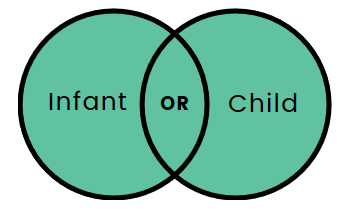
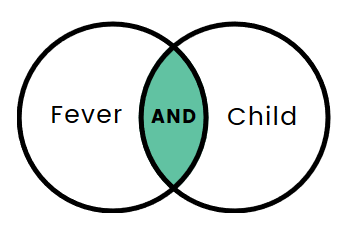
Use the OR operator to combine terms that are related to one another. OR widens your search.
Use the AND operator to combine different concepts. AND narrows your search.
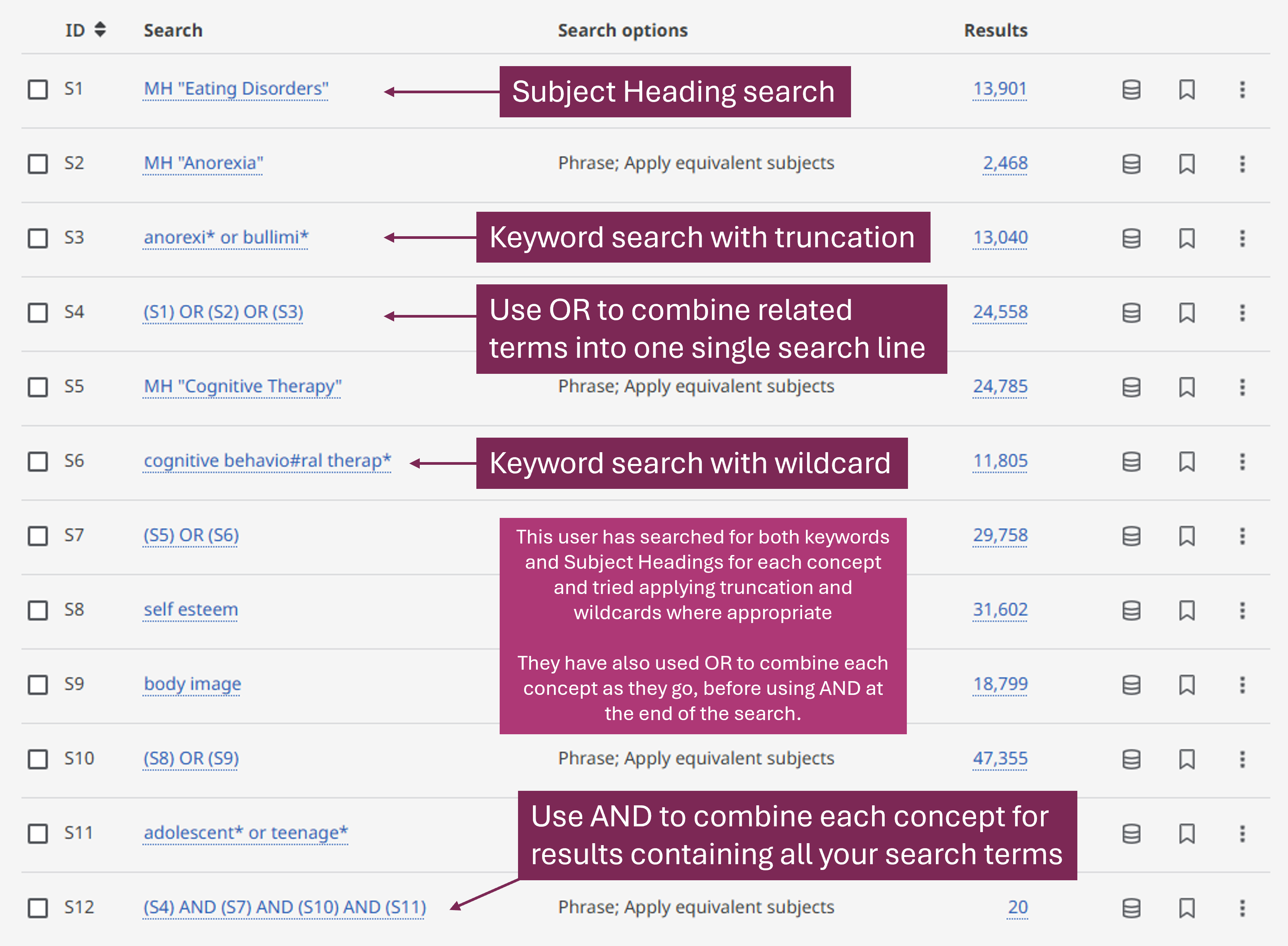
Look at this example search below. Here, the user wants to answer the question:
“Is CBT effective at improving the self-esteem of young people with eating disorders?”
It is by no means exhaustive but gives you an idea of how your search might look like as you build it within EBSCOhost.

Depending on the nature of your search, you might want to apply limits to your search to remove irrelevant articles.
Different databases offer different ways of restricting your search, but common limits include language, publication date or publication type.
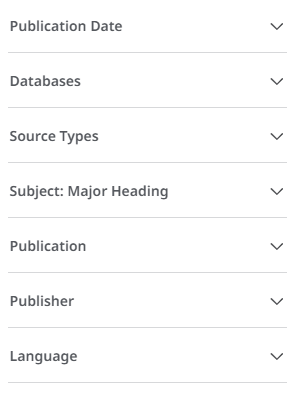
In EBSCOhost, a selection of limits is available in the menu to the left of your search results.
Choose those that are relevant and they will be applied automatically to your last search line. You should always apply limits at the end of your search
 Searching is rarely completely accurate on your first try. You may need to try different combinations of search terms, both keyword and subject headings, to improve the relevancy of your results.
You may have already found useful papers elsewhere – perhaps from a Google search. Examine the keywords and subject headings in these papers and build them into your search if you’ve not used them already.
Too many results?
Too few results?
Results not relevant enough?
If you haven’t already done so, create a personal EBSCOhost account. This will allow you to save your search strategies so that they can be run again later or saved as an alert so that you can receive email updates when new papers are published.
There are a few ways to save your searches:
There are other ways to save results too:

Click here for video tutorials from the publisher.

Email beth.jackson@uhcw.nhs.uk and book a 1-2-1 session with your Knowledge Skills Librarian.
 Guide written by Beth Jackson, Knowledge Skills Librarian, UHCW NHS Trust.